The Method

One Governed Source of Truth.

How can one engineer execute what used to take a team — without adding headcount, software, or hardware? Collect data once, decompose it with AI, input a specification, and AI generates — and executes — solution sets in parallel.

Why This Scales

Serial execution is capped by headcount.

Parallel execution isn’t — that’s the whole difference.

As-is workflow

Fixed resources, serial progression.

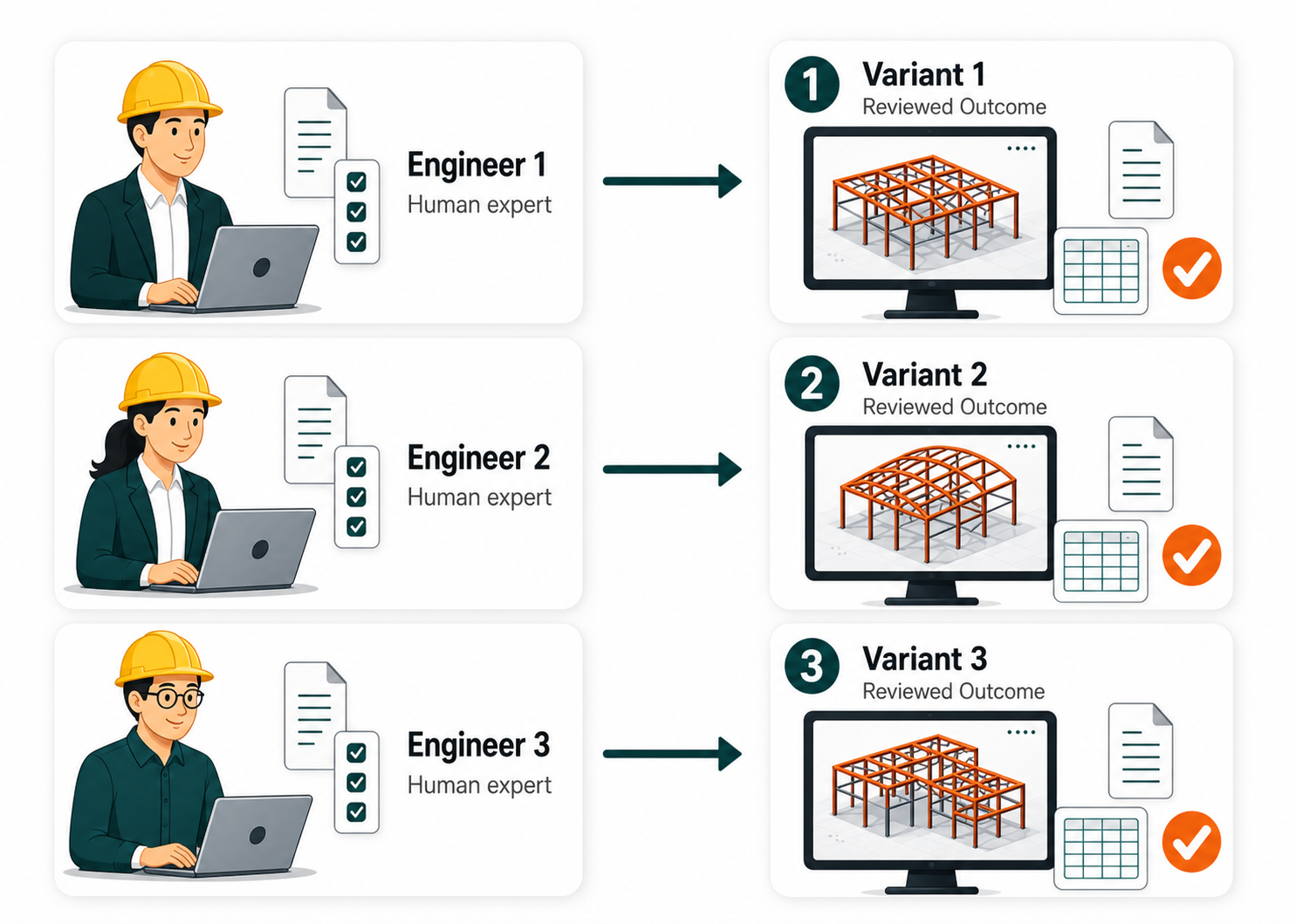
As-is engineering workflow scenario with multiple engineers producing separate reviewed variants

To scale up in the as-is scenario, you add resources at a 1:1 ratio. Scaling down means paying for unused resources. The cost of doing business is fixed: one engineer executes one deliverable, in a serial progression.

To-be: AI-optimized

Flexible resources, parallel execution.

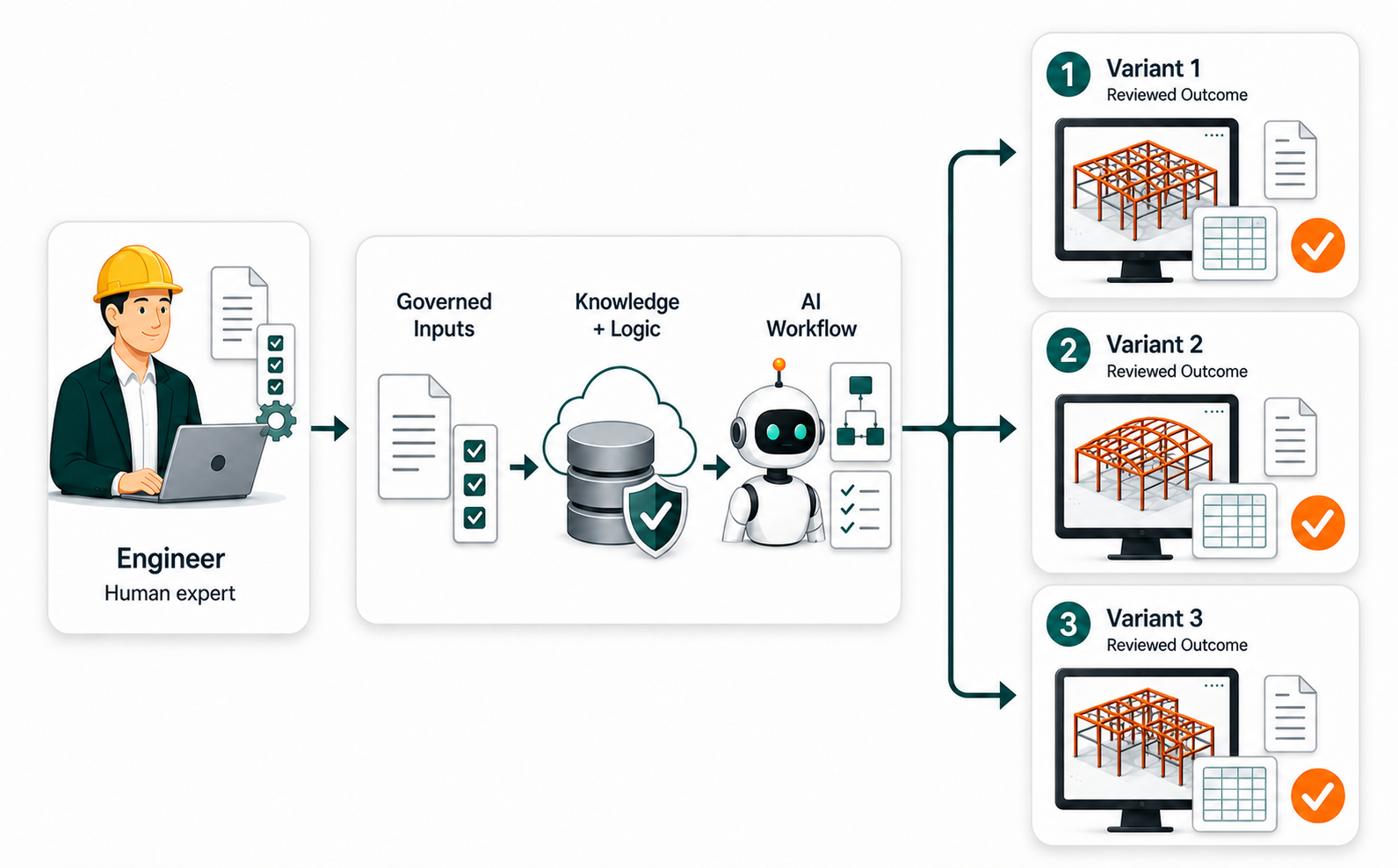
AI optimized workflow scenario with governed inputs, expert supervision, automation, and parallel reviewed outputs

To scale up in the to-be workflow, one engineer executes multiple projects or outcomes in parallel. Scaling up or down is a matter of how many parallel processes the engineer manages — not how many additional engineers, software licenses, or machines you add. The same resources, at no additional cost, and the savings grow the more parallel jobs are running.

Set the scale factor: 1 engineer = 1 outcome (traditional, no scaling) → 1 engineer × f(x) = 3 outcomes (scale) → 3 engineers × f(x) = 9 outcomes (scale up). The multiplier comes from parallel, AI-assisted execution — not from adding headcount.

The Workflow

Five components, in order, every time.

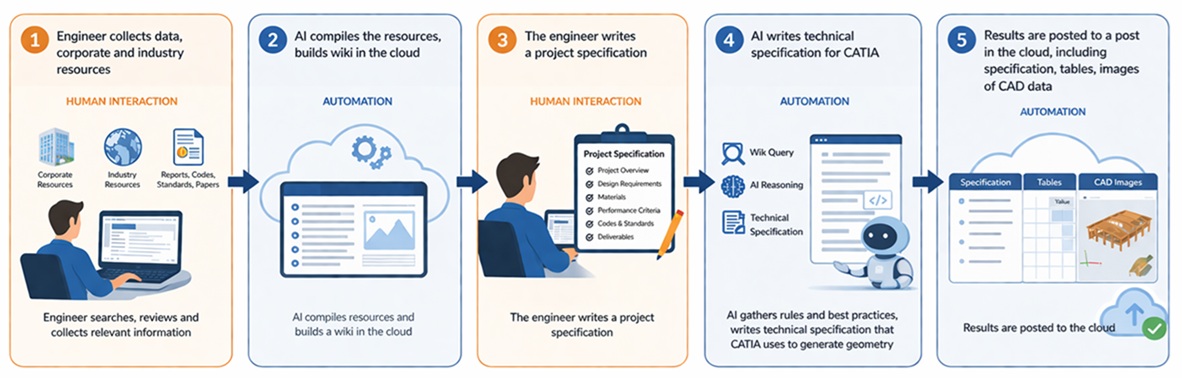
Five-component AI engineering workflow: the engineer collects corporate and industry data, AI compiles the resources into a governed knowledge base, the engineer writes a project specification, AI generates solution sets, and results are delivered as 3D data, 2D data, and documentation
The loop: collect, decompose, specify, generate, deliver — then feed lessons learned back into the first component.
01 Collect

Company best practice, engineering and manufacturing rules, and customer or project history go into the 3DEXPERIENCE database — a one-time effort that keeps paying off. Every project afterward adds its own lessons learned back into the same governed record.

  • Company best practice
  • Engineering and manufacturing rules
  • Customer or project historical data
  • Single source of truth — trusted, governed data
02 Decompose

AI reads what was collected, then organizes and relates it — categorizing rules, precedents, and history so they can be queried instead of just stored. This is what turns a data dump into structure AI can actually act on.

  • AI job to read the data
  • Organize the data
  • Categorize and relate the data
03 Specify

This is the one manual input the system still needs: a specification, stated per project and per customer. Every customer has unique product requirements to meet, product by product.

  • Per-project, per-customer effort
  • Product by product — unique requirements each time
04 Generate

AI analyzes the specification against the governed company data and proposes solution sets — not one answer, but several, with engineers in the loop to steer and review. This is where the multiplication factor begins.

  • AI analyzes the input and company data
  • Proposes solution sets, not a single answer
  • Multiple solutions processed in parallel, engineers in the loop
05 Deliver

There are potentially multiple solutions worth generating, and executing them in parallel — with the engineer approving each one — is what optimizes resources. This is the component that produces the outputs, ready to hand off.

  • 3D data
  • 2D data
  • Documentation
  • Parallel execution — optimizing people, software, hardware, and time
From Method to Your Project

See what this looks like applied to your project.

Describe what you are building and I will help you see whether this workflow fits, what data needs to be governed first, and what a proof of concept would need to show.